Optical gas sensing built around molecular fingerprints

Wren Sensing is developing a near infrared optical sensing platform using fibre Bragg grating technology. Our development focuses on methane, carbon dioxide and ethylene, with an industry collaborator and research partners helping investigate practical measurement problems.

Current stage: field testing

Methane and carbon dioxide: on-farm livestock field trials. Ethylene: controlled atmosphere fruit storage target.

Reading a gas by the light it absorbs

As light passes through a gas, characteristic frequencies are absorbed from the light, giving each gas a unique pattern we can match. Our platform works with near infrared light, which lies just beyond the red end of the visible spectrum and where many gases have such features.

A fibre Bragg grating is a structure written into an optical fibre that reflects selected frequencies of light. Our approach uses a spectral response which can match over 50 absorption lines of the target gas, as part of an optical measurement system.

Three priorities for development

Selectivity in mixed gases

A measurement must distinguish the target gas where other compounds affect the signal, such as methane in humid environments or ethylene among other volatile organic compounds. Matching many absorption lines makes the measurement highly specific to the target gas. We run selectivity tests with interfering gases present.
Measuring low concentrations

Some applications depend on detecting small concentrations or small changes. Our sensors are designed to measure concentrations in parts per million (ppm) or even parts per billion (ppb). Detection performance depends on the gas, configuration, sampling conditions and measurement time.

Measuring multiple gases

Our platform can measure multiple gases simultaneously by selecting some absorption lines from each gas. We have demonstrated this with methane and carbon dioxide.

Development across three gases

Methane · CH4

On-farm field trials with cattle and sheep; see field testing.

Carbon dioxide · CO2

Measured in our on-farm field trials alongside methane. Checked against an existing sensor in the laboratory, with a field comparison to follow.

Ethylene · C2H4

A target application in controlled atmosphere fruit storage, aiming for measurements in the tens of parts per billion. Monitoring in orchards is exploratory.

Assessing fit for your measurement

Each sensor is tested automatically against calibrated gas canisters, and we run selectivity tests with interfering gases present. A result applies to the gas, instrument version and conditions it was measured under, so we assess evidence against each application’s requirements.

Testing in agricultural environments

Field testing takes the sensor out of the laboratory and onto a working farm. With cattle and sheep, it measures methane and carbon dioxide in real conditions and its methane readings are compared with an existing methane sensor. Carbon dioxide has so far been checked against an existing sensor in the laboratory, with a field comparison to follow.

The research behind our sensors

Our sensor technology is powered by University of Sydney research. The 2024 study below demonstrated the grating approach in the laboratory, using acetylene as a test gas.

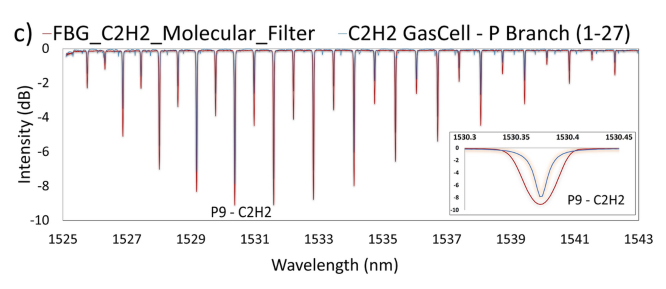
Graph of intensity in decibels against wavelength from 1,525 to 1,543 nanometres. The custom grating's 27 dips (red) line up with acetylene's absorption lines measured in a gas cell (blue). An inset enlarges line P9 near 1530.4 nanometres.
Acetylene research figure: the custom grating’s response (red) closely matches the 27 acetylene absorption lines it was designed to mimic (blue). Laboratory research, not our current instrument. From Rahme et al., Scientific Reports 14, 9939 (2024), Figure 1c, licensed under CC BY 4.0; cropped to panel (c).

A new gas detection technique through cross-correlation with a complex aperiodic FBG

Research demonstration · Acetylene (C2H2) · Laboratory

Matthew Rahme, Peter Tuthill, Christopher Betters, Maryanne Large and Sergio Leon-Saval. Scientific Reports 14, 9939 (2024). DOI: 10.1038/s41598-024-59841-7. Open access under a Creative Commons Attribution 4.0 licence.

The study demonstrates optical cross-correlation with a customised fibre Bragg grating, using acetylene as the test gas.

How the published demonstration works

  1. Match: a custom grating mimics 27 acetylene absorption lines between about 1,525 and 1,543 nanometres.
  2. Sweep: stretching the grating moves its pattern in and out of line with the gas’s lines.
  3. Read: the deeper the dip in the signal, the more acetylene is present.

Interfering gases were imitated with separate gas cells: carbon monoxide had no detectable effect and hydrogen cyanide changed the reading by 3.7 ± 1.0%.

This research was published in 2024; our sensor has improved even more since then!

Bring us your gas measurement challenge

Tell us which gases you need to measure, the environment involved and what a successful evaluation would establish. We welcome funded joint development, technology integration and projects for a specific application.

Planning a research study or field evaluation? Propose a field trial.

Interested in a future sensor? Register sensor interest.